2
Followers
3
Following

The Welsh Bookworm
The Welsh Bookworm is a librarian living and working in rural Minnesota. She is a past-president of the St. David’s Society of Minnesota, leads the Welsh folk-dance group Traed Y Ddraig, and teaches Welsh language classes. Her Welsh Bookworm column was featured occasionally in the newspaper Y Drych, now part of Ninnau.
Laurel works for the Carver County Public Libraries in Waconia and Norwood Young America, loves reading, music, dance, languages, genealogy, gardening, and bird watching.
Laurel reads historical fiction, mysteries, sci fi/fantasy, medieval and British history, Arthurian fiction, classics, and of course, anything connected to Wales. Follow my blog at http://welshbookworm.wordpress.com


 Possible spoiler alert! I knew the basic outline of the story of Frank and Mamah going into it, so I dreaded getting to end of it. Nancy Horan created a very sympathetic portrayal of Mamah - and I really wanted them to have more time together. Probably Frank's ego and narcissism would have meant that he eventually would have cheated on her. And if Mamah had grown enough to leave him, perhaps she would have gone on to an illustrious career. As it was, these two kindred spirits had a kind of co-dependent relationship that both helped and hindered their individual lives. I think Nancy Horan did a marvelous job with the historical information available to her of staying true to the characters and the time period, and yet getting inside their heads in a very believable way. There were a few gaps in the story where the narrative either glossed over large chunks of time or could have been fleshed out with more details, but I think Ms. Horan wanted to avoid making up anything that wasn't supported by her research. As it was, she worked an enormous amount of detail into the story, surrounding it with a very elegant style of prose that beautifully evoked the time period, and flowed in a very readable manner. I could have wished for a list of her sources or suggestions for further reading at the end of the book.
Having also listened to T.C. Boyle's "The Women", it probably enhanced my understanding of how strongly Frank and Mamah were bound to each other, and how her death affected the rest of his life. Whatever good qualities had drawn her to him died with her and left a hole that he could never fill.
Book Description (from Amazon.com)
"I have been standing on the side of life, watching it float by. I want to swim in the river. I want to feel the current." So writes Mamah Borthwick Cheney in her diary as she struggles to justify her clandestine love affair with Frank Lloyd Wright. Four years earlier, in 1903, Mamah and her husband, Edwin, had commissioned the renowned architect to design a new home for them. During the construction of the house, a powerful attraction developed between Mamah and Frank, and in time the lovers, each married with children, embarked on a course that would shock Chicago society and forever change their lives. In this ambitious debut novel, fact and fiction blend together brilliantly. While scholars have largely relegated Mamah to a footnote in the life of America’s greatest architect, author Nancy Horan gives full weight to their dramatic love story and illuminates Cheney’s profound influence on Wright.
I listened to the audio version narrated by Joyce Bean.
 I first read this so long ago, that I do not remember reading it. Definitely written for children, Tolkien wrote this 30+ years before The Lord of the Rings. Here, the famous ring is just a magic ring of invisibility, without the dark overtones and corrupting power that it would acquire later. That is not to say that the book can't also be enjoyed by teens and adults, although I found the silly rhyming names of the dwarves to be somewhat distracting. Tolkien did go back and revise The Hobbit so that the version we have now is more in line with what he wrote later after developing the world of Middle Earth. We can imagine that perhaps this is the version of his adventures that Bilbo wrote to tell his nieces and nephews. I can definitely identify with Bilbo's conflicting needs for adventure and security. But it is through adventure, through stretching ourselves, and leaving our comfort zones, that we grow as human beings. This is also a cautionary tale about greed. I look forward to seeing what Peter Jackson has done with the movie, and I'll also be taking a look at The Annotated Hobbit.
Description: A great modern classic and the prelude to The Lord of the Rings. Bilbo Baggins is a hobbit who enjoys a comfortable, unambitious life, rarely traveling any farther than his pantry or cellar. But his contentment is disturbed when the wizard Gandalf and a company of dwarves arrive on his doorstep one day to whisk him away on an adventure. They have launched a plot to raid the treasure hoard guarded by Smaug the Magnificent, a large and very dangerous dragon. Bilbo reluctantly joins their quest, unaware that on his journey to the Lonely Mountain he will encounter both a magic ring and a frightening creature known as Gollum.
 This is everything I love about historical novels and family sagas: big, sweeping, panoramic, enough history to understand the context, enough detail to put me in that time and place, characters that I care about, a little romance, a lot of adventure, and a satisfying ending. This caught my attention in connection with my Moby-Dick project because it had the word "sea" in the title. Other than that, there is no connection. It is not a sea story. For information and pictures of the cathdral see http://www.aviewoncities.com/barcelona/santamariadelmar.htm . I listened to an audio recording of the book. Otherwise I would have been stumbling over the pronunciation of Spanish names and places. It had me sitting in my garage on multiple occasions after driving home from work because I didn't want to stop the narrative. Arnau begins life as the son of a runaway serf, joins the guild of the bastaix (porters who unload the cargo from the ships in the harbor) who carry stones from the quarry to the building site on their own time because of their dedication to the Virgin of the Sea. Through Arnau's eyes, we see life in Barcelona during times of famine and plague, relations with the Jews, the Inquisition, war, the growing maritime prosperity of Catalonia and the merchant classes, and the role of religion and faith from differing perspectives. Arnau is a good man at his core, but he is not above exacting revenge on those who have harmed him and those he loves. Well researched, I did not mind the historical asides, and learned a lot about a less familiar region of medieval Europe.
Description:
In the tradition of Ken Follett’s The Pillars of the Earth, here is a thrilling historical novel of friendship and revenge, plague and hope, love and war, set in the golden age of 14th-century Barcelona. Arnau Estanyol arrives in Barcelona and joins the powerful guild of stone-workers building the magnificent cathedral of Santa Maria del Mar, while his adoptive brother Joan studies to become a priest. As Arnau prospers, he secretly falls in love with a forbidden woman. When he is betrayed and hauled before the Inquisitor, he finds himself face-to-face with his own brother. Will he lose his life just as his beloved cathedral is finally completed, or will his brother spare him?
 Straightforward and easily readable. This is a no-nonsense overview of Native American history, culture, politics, and religion. Includes a bibliography for further reading.
Description:
What have you always wanted to know about Indians? Do you think you should already know the answers—or suspect that your questions may be offensive? In matter-of-fact responses to over 120 questions, both thoughtful and outrageous, modern and historical, Ojibwe scholar and cultural preservationist Anton Treuer gives a frank, funny, and sometimes personal tour of what’s up with Indians, anyway.
• What is the real story of Thanksgiving?
• Why are tribal languages important?
• What do you think of that incident where people died in a sweat lodge?
White/Indian relations are often characterized by guilt and anger. Everything You Wanted to Know about Indians But Were Afraid to Ask cuts through the emotion and builds a foundation for true understanding and positive action.
 The first book in this series was such a brilliant debut, that I just couldn't give this one 5 stars, but nevertheless, I enjoyed it immensely. Flavia is a wonderful, precocious, almost scary child. The mystery wasn't quite as compelling in this one - Flavia is never in any great danger - so it comes across as more of a cozy than the first book. But we have all of the same wonderful characters and a few new ones - Dieter, a German POW, Mad Meg, and Aunt Felicity, who might be the only adult who understands and appreciates Flavia. And we have some delightfully humorous situations - the vicar naked in the woods, the two tea room ladies with their Russian samovar (almost a character in its own right), Mad Meg and her penchant for shiny objects, Flavia's sisters constant attempts to convince Flavia that she is adopted, and the opening with Flavia imagining her own funeral. I recently "reread" the first book on audio, and followed up with this one. The narrator Jayne Entwistle has the perfect voice for Flavia. Highly recommended.
Book Description: Flavia de Luce, a dangerously smart eleven-year-old with a passion for chemistry and a genius for solving murders, thinks that her days of crime-solving in the bucolic English hamlet of Bishop’s Lacey are over—until beloved puppeteer Rupert Porson has his own strings sizzled in an unfortunate rendezvous with electricity. But who’d do such a thing, and why? Does the madwoman who lives in Gibbet Wood know more than she’s letting on? What about Porson’s charming but erratic assistant? All clues point toward a suspicious death years earlier and a case the local constables can’t solve—without Flavia’s help. But in getting so close to who’s secretly pulling the strings of this dance of death, has our precocious heroine finally gotten in way over her head?
Series info:
#2 of series
See: The sweetness at the bottom of the pie
 I love the premise of this book, being a researcher and historian myself. I also like investigations into the paranormal. However - this ends up bordering on magic and fantasy. The historical side of the story was very well done. I would like to have learned more about these women and their relationships with their daughters. It's interesting to see Connie's mother covering up her magical abilities in New Age mysticism, and to show the relationship develop between Connie and her mother. I did find it a little hard to swallow the idea that Connie is only learning of her own paranormal abilities in her twenties. I also wish that the psychic and paranormal elements had been more "ordinary" and less fantastical. The love story between Connie and Sam the steeplejack was sweet. I wouldn't call this a mystery exactly, since the clues were obvious to the reader, nor is it a thriller. You'll know who the bad guy is long before Connie does. I listened to the audiobook, so the phonetic dialect spellings didn't bother me. On the other hand, I wasn't at all convinced by the narrator's (Katherine Kellgren) Boston accent.
Description: Harvard graduate student Connie Goodwin plans on dedicating her summer to research. Her plans begin to fall into place when she is tasked with selling her grandmother's reclusive Salem home. However, upon discovering a seventeenth-century Bible, Connie unwittingly walks into an ancient mystery and embarks on a quest to discover a book that contains ultimate knowledge.
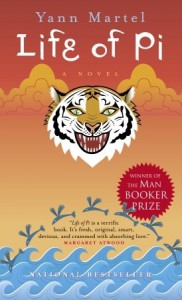 I loved the first third of this book. I loved Pi and his rambling thoughts about life, animals, religion, and experience. 5 stars up to that point. But after the shipwreck it drifted down to 3 stars, so I'll give it 4 overall. The lifeboat experiences became tedious, too many gory details, although perhaps it was intended to portray the monotony of endless days just trying to survive. This is not a fantasy novel. But it is not quite allegory either. It reminds me of a phrase we use at church after the reading of scripture. "I don't know if it really happened this way, but I know the story is true." This book is not what I expected. It is a witness to the worst that can happen to a human being and how we frame our experiences in light of whatever beliefs we have about life, God and the universe that allow us to survive and make sense of things without going insane. I look forward to seeing the movie.
Book Description: Piscine Molitor Patel, nicknamed Pi, lives in Pondicherry, India, where his family runs a zoo. Little Pi is a great reader. He devours books on Hinduism, Christianity and Islam, and to the surprise of his secular parents, becomes devoted to all three religions. When the parents decide to emigrate to Canada, the family boards a cargo ship with many of the animals that are going to new zoological homes in North America, and bravely sets sail for the New World. Alas, the ship sinks. A solitary lifeboat remains bobbing on the surface of the wild blue Pacific. In it are five survivors: Pi, a hyena, a zebra, an orangutan and a 450-pound Bengal tiger. With intelligence, daring and inexpressible fear, Pi manages to keep his wits about him as the animals begin to assert their places in the foodchain; it is the tiger, Richard Parker, with whom he must develop an inviolable understanding.
 A slim and very readable summation of what makes Moby-Dick great. It almost makes me want to reread it again now.
Description:
Moby-Dick is perhaps the greatest of the Great American Novels, yet its length and esoteric subject matter create an aura of difficulty that too often keeps readers at bay. Fortunately, one unabashed fan wants passionately to give Melville's masterpiece the broad contemporary audience it deserves. In his National Book Award- winning bestseller, In the Heart of the Sea, Nathaniel Philbrick captivatingly unpacked the story of the wreck of the whaleship Essex, the real-life incident that inspired Melville to write Moby- Dick. Now, he sets his sights on the fiction itself, offering a cabin master's tour of a spellbinding novel rich with adventure and history.
Philbrick skillfully navigates Melville's world and illuminates the book's humor and unforgettable characters-finding the thread that binds Ishmael and Ahab to our own time and, indeed, to all times. A perfect match between author and subject, Why Read Moby-Dick? gives us a renewed appreciation of both Melville and the proud seaman's town of Nantucket that Philbrick himself calls home. Like Alain de Botton's How Proust Can Change Your Life, this remarkable little book will start conversations, inspire arguments, and, best of all, bring a new wave of readers to a classic tale waiting to be discovered anew.
Quotes:
"Contained in the pages of Moby-Dick is nothing less than the genetic code of America: all the promises, problems, conflicts, and ideals that contributed to the outbreak of a revolution in 1775 as well as a civil war in 1861 and continue to drive this country's ever-contentious march into the future. This means that whenever a new crisis grips this country, Moby-Dick becomes newly important. It is why subsequent generations have seen Ahab as Hitler during World War II or as a profit-crazed deep-drilling oil company in 2010 or as a power-crazed Middle Eastern dictator in 2011." - p. 6
"The novel has inspired plays, films, operas, comic books, a television miniseries, and even a pop-up book. Those who have never read a word of it know the story of Ahab and the White Whale." - p. 8
 Setting: England, Hatfield House
Time: 1558
Main characters: Princess Elizabeth, Kate Haywood - musician
First paragraph, Prologue: "It was a frozen, gray day. The sun hid behind roiling banks of clouds and sent not even a ray of reassuring light to the earth below, which was eerily silent. There were no shouts in the streets, no cries from merchants selling hot cider or roasted almonds, no quarrels or laughter. The river was empty of boats, and the crowds on London Bridge scurried on their business with their muffled heads down."
Favorite lines:
Description: 1558. Kate Haywood, a simple musician in the employ of a princess, will find herself involved in games of crowns as she sets out to solve the murder of the queen’s envoy. England is in tumult under the rule of Queen Mary and her Spanish husband. Confined to house arrest at Hatfield House, young Princess Elizabeth is the country’s greatest hope. Far from court intrigues, Elizabeth finds solace in simple things: the quiet countryside and peaceful recreation, including the melodies of her chief musician and his daughter, Kate Haywood. But Kate will prove herself most valuable when an envoy of the queen—sent to flush out heretics in the princess’s household—is found dead on the grounds of Hatfield. Acting as Elizabeth’s eyes and ears, Kate is sent out on the trail of a killer whose mission could destroy her family, friends—and the future of England.
About the author:
Series info:
#1 Murder at Hatfield House
#2 Murder at Westminster Abbey (April 2014)
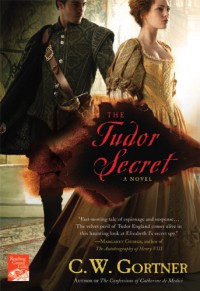 Setting: England, London, Whitehall Palace
Time: 1602, 1553
Main characters: Brendan Prescott - an orphan raised in the Dudley household, Princess Elizabeth, Edward VI, William Cecil - Baron Burghley.
First paragraph: "Everyone has a secret.
Like the oyster with its grain of sand, we bury it deep within, coating it with opalescent layers, as if that could heal our mortal wound. Some of us devote our entire lives to keeping our secret hidden, safe from those who might pry it from us, hoarding it like the pearl, only to discover that it escapes us when we least expect it, revealed by a flash of fear in our eyes when caught unawares, by a sudden pain, a rage or hatred, or an all-consuming shame."
Favorite lines:
Description: The era of the Tudors was one of danger, intrigue, conspiracy, and, above all, spies. Summer 1553: A time of danger and deceit. Brendan Prescott, an orphan, is reared in the household of the powerful Dudley family. Brought to court, Prescott finds himself sent on an illicit mission to the king’s brilliant but enigmatic sister, Princess Elizabeth. But Brendan is soon compelled to work as a double agent by Elizabeth’s protector, William Cecil, who promises in exchange to help him unravel the secret of his own mysterious past. A dark plot swirls around Elizabeth’s quest to unravel the truth about the ominous disappearance of her seriously ill brother, King Edward VI. With only a bold stable boy and an audacious lady-in-waiting at his side, Brendan plunges into a ruthless gambit of half-truths, lies, and murder. Filled with the intrigue and pageantry of Tudor England, The Tudor Secret is the first book in The Elizabeth I Spymaster Chronicles.
About the author: C.W. Gortner holds an MFA in Writing, with an emphasis in Renaissance Studies. Raised in Spain and half Spanish by birth, he currently lives in the San Francisco Bay Area.
Series info:
#1 The Tudor Secret
#2 The Tudor Conspiracy
 Setting: England, Derbyshire, Hardwick Manor, London
Time: 1539-1567, Prologue and Epilog 1603
Main characters: Elizabeth Hardwick Talbot - Countess of Shrewsbury, Elizabeth Brooke - eventually wife of William Parr (brother of Katherine Parr)
First paragraph, Prologue: "She stood at the westward-facing window of her bed-chamber. The sun was poised to slip over the horizon, and its rays slanted across the rolling hills and fields as though in a last desperate attempt to cling to the rolling ball of the earth. The sky was shot with pink and gold, the underside of the drifting clouds aflame with the sun's dying glory.
The queen was dead."
Favorite lines:
Description: The author of The September Queen explores Tudor England with the tale of Bess of Hardwick—the formidable four-time widowed Tudor dynast who became one of the most powerful women in the history of England. On her twelfth birthday, Bess of Hardwick receives the news that she is to be a waiting gentlewoman in the household of Lady Zouche. Armed with nothing but her razor-sharp wit and fetching looks, Bess is terrified of leaving home. But as her family has neither the money nor the connections to find her a good husband, she must go to facilitate her rise in society. When Bess arrives at the glamorous court of King Henry VIII, she is thrust into a treacherous world of politics and intrigue, a world she must quickly learn to navigate. The gruesome fates of Henry’s wives convince Bess that marrying is a dangerous business. Even so, she finds the courage to wed not once, but four times. Bess outlives one husband, then another, securing her status as a woman of property. But it is when she is widowed a third time that she is left with a large fortune and even larger decisions—discovering that, for a woman of substance, the power and the possibilities are endless.
About the author: Gillian uses her years of experience in theatre an actress, director, and producer to help authors give effective public readings, through workshops and private coaching. Her life-long fascination with British history and dedication to research infuse her novels with a compelling evocation of time and place, and provide fodder for her non-fiction writing, including articles on "Frost Fairs on the River Thames," "The Royal Miracle: The Biggest What-If in English History," and "1660: The Year of the Restoration of Theatre".
 Setting: Sweden, England, London, Whitehall Palace and various
Time: 1564-1603
Main characters: Elizabeth I, Helena (Elin) von Snakenborg, William Parr (brother of Katherine Parr)
First paragraph: "I may have been a maiden just shy of seventeen years of age, but I was no simpleton. I recognized beard burn on the fair face of my sister when she emerged, breathless, from a small closet off one of the king's galleries."
Favorite lines:
Description: From the acclaimed author of To Die For comes a stirring novel told that sheds new light on Elizabeth I and her court. Sandra Byrd has attracted countless fans for evoking the complexity, grandeur, and brutality of the Tudor period. In her latest tour de force, she poses the question: What happens when serving a queen may cost you your marriage—or your life? In 1565, seventeen-year-old Elin von Snakenborg leaves Sweden on a treacherous journey to England. Her fiance has fallen in love with her sister and her dowry money has been gambled away, but ahead of her lies an adventure that will take her to the dizzying heights of Tudor power. Transformed through marriage into Helena, the Marchioness of Northampton, she becomes the highest-ranking woman in Elizabeth’s circle. But in a court that is surrounded by Catholic enemies who plot the queen’s downfall, Helena is forced to choose between an unyielding monarch and the husband she’s not sure she can trust—a choice that will provoke catastrophic consequences. Vividly conjuring the years leading up to the beheading of Mary Queen of Scots, Roses Have Thorns is a brilliant exploration of treason, both to the realm and to the heart.
About the author: Best-selling author Sandra Byrd has published nearly three dozen fiction and nonfiction books including her new Tudor-set series, Ladies in Waiting. Book 1, To Die For: A Novel of Anne Boleyn launched in 2011. Book 2, The Secret Keeper: A Novel of Kateryn Parr will debut in June, 2012. Her other titles include the French Twist series, which includes the Christy finalist Let Them Eat Cake (2007) and its sequels, Bon Appétit (2008) an Piece de Resistance (2009) as well as the London Confidential series for tweens. For nearly a decade Sandra has shared her secrets with the writing students she mentors and coaches. Before turning to full-time writing, Sandra was an acquisitions editor. She lives in the Seattle, Washington, area with her husband, two children, and little dog.
Series info:
#1 To Die For
#2 The Secret Keeper
#3 Roses Have Thorns
 Setting: England, London, Greenwich Palace, Richmond Palace, Bridewell Palace, Hever Castle, Windsor Castle
Time: 1523-1525
Main characters: Henry VIII, Anne Boleyn, Thomas Wyatt - poet
First paragraph: "A deep breath is all it takes to enter a room.
Or to scream.
Or both.
I stand against a wall, five strides from the great oak door of the queen's apartments. The guard watches me sideways, pretending he's not. Pretending he's focused on the stairwell. The pretense fails to deceive me."
Favorite lines:
Description: Anne Boleyn is the odd girl out. Newly arrived to the court of King Henry VIII, everything about her seems wrong, from her clothes to her manners to her witty but sharp tongue. So when the dashing poet Thomas Wyatt offers to coach her on how to shine at court—and to convince the whole court they’re lovers—she accepts. Before long, Anne’s popularity has soared, and even the charismatic and irresistible king takes notice. More than popularity, Anne wants a voice—but she also wants love. What began as a game becomes high stakes as Anne finds herself forced to make an impossible choice between her heart’s desire and the chance to make history.
About the author:
Series info:
#1 Gilt
#2 Tarnish

Zadok's Treasure (Penny Spring and Sir Toby Glendower Mystery Series)
 Series info:
#3 of series
See: Exit Actors, Dying
